What information should a company collect before starting an LCA calculation?


Martta Ääri
23.1.2026
LCA is not a single calculation, but a set of life cycle modules that describe the product’s journey from raw materials to end of life and potential recycling benefits.
In this article, we review the key LCA modules and the type of data companies should collect for each.
A1–A3: Raw materials, transport, and manufacturing
(Mandatory modules)
The A1–A3 modules describe the creation of the product and form the foundation of the LCA calculation.
Companies should collect information on topics such as:
- raw materials used and material quantities
- origin of materials and suppliers
- energy used in production
- manufacturing processes and production technologies
This data directly reflects the product’s environmental impact during the manufacturing phase.
A4–A5: Transport to site and installation
(Mandatory in certain cases)
The A4–A5 modules cover delivery to the place of use and the installation or construction phase. These are particularly relevant for construction and infrastructure products.
Companies should collect information on topics such as:
- transport distances and transport modes
- fuels used and logistics chains
- energy use during installation
- waste generated during installation
B1–B7: Use phase
(Scenario-based, often optional modules)
The use phase describes the environmental impacts during the actual use of the product. The scope of these modules depends on the nature and application of the product.
Companies should collect information on topics such as:
- the estimated service life of the product
- maintenance and repair requirements
- replacement or renewal of components
- energy or water use during operation
Not all B-modules are required for all products.
C1–C4: End-of-life stage
(Mandatory modules)
The C-modules describe the end of the product’s life cycle and waste management.
Companies should collect information on topics such as:
- demolition or removal methods
- transport of waste
- waste treatment and final disposal
- handling of materials at end of life
This information is essential for assessing the product’s overall environmental impact.
D: Benefits beyond the system boundary
(Mandatory module)
The D-module describes potential environmental benefits that occur after the life cycle, such as recycling or energy recovery.
Companies should collect information on topics such as:
- recycling rates of materials
- reuse or material substitution
- energy recovery from waste
This module highlights positive impacts beyond the product’s life cycle.
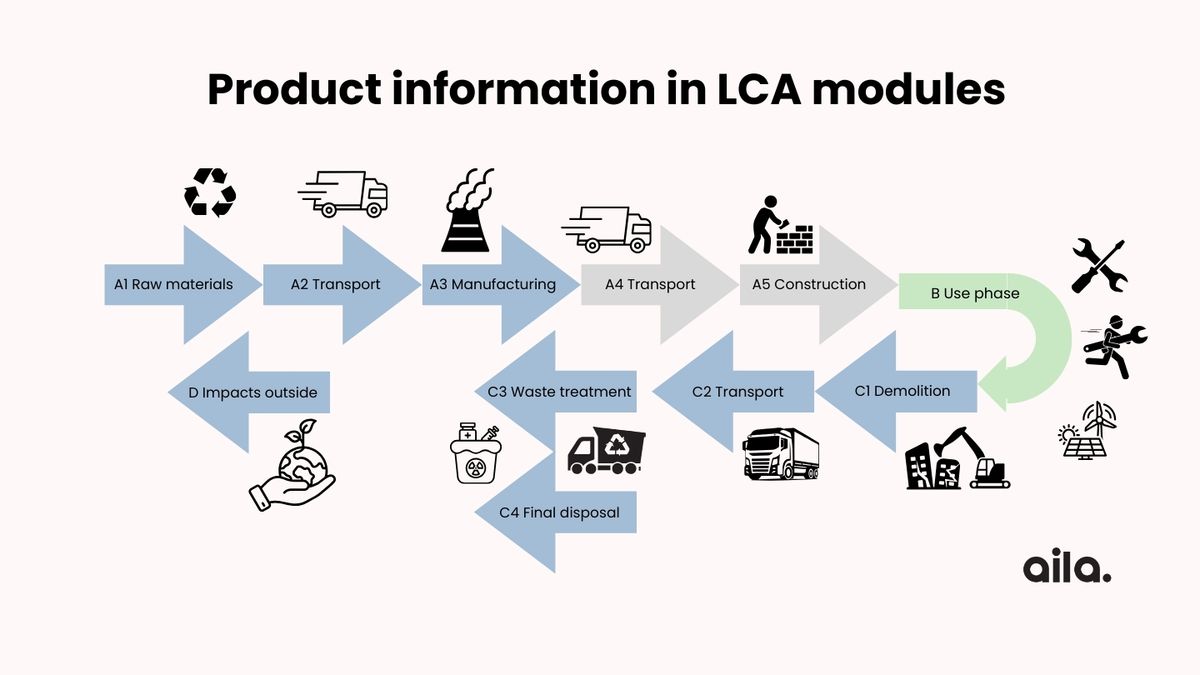
Summary: input data makes the difference
In all cases, companies do not need to produce complete and highly detailed data for every module. What matters most is that:
- the input data reflects the actual life cycle of the product
- data is collected systematically
- assumptions and boundaries are clear and documented
The higher the quality and consistency of the input data, the more reliable and versatile the LCA results will be. A well-structured LCA dataset supports not only the EPD process but also sustainability reporting, supply chain requests, and customer requirements.


